


Android App Development
By Grant Crawley · 6 June 2026
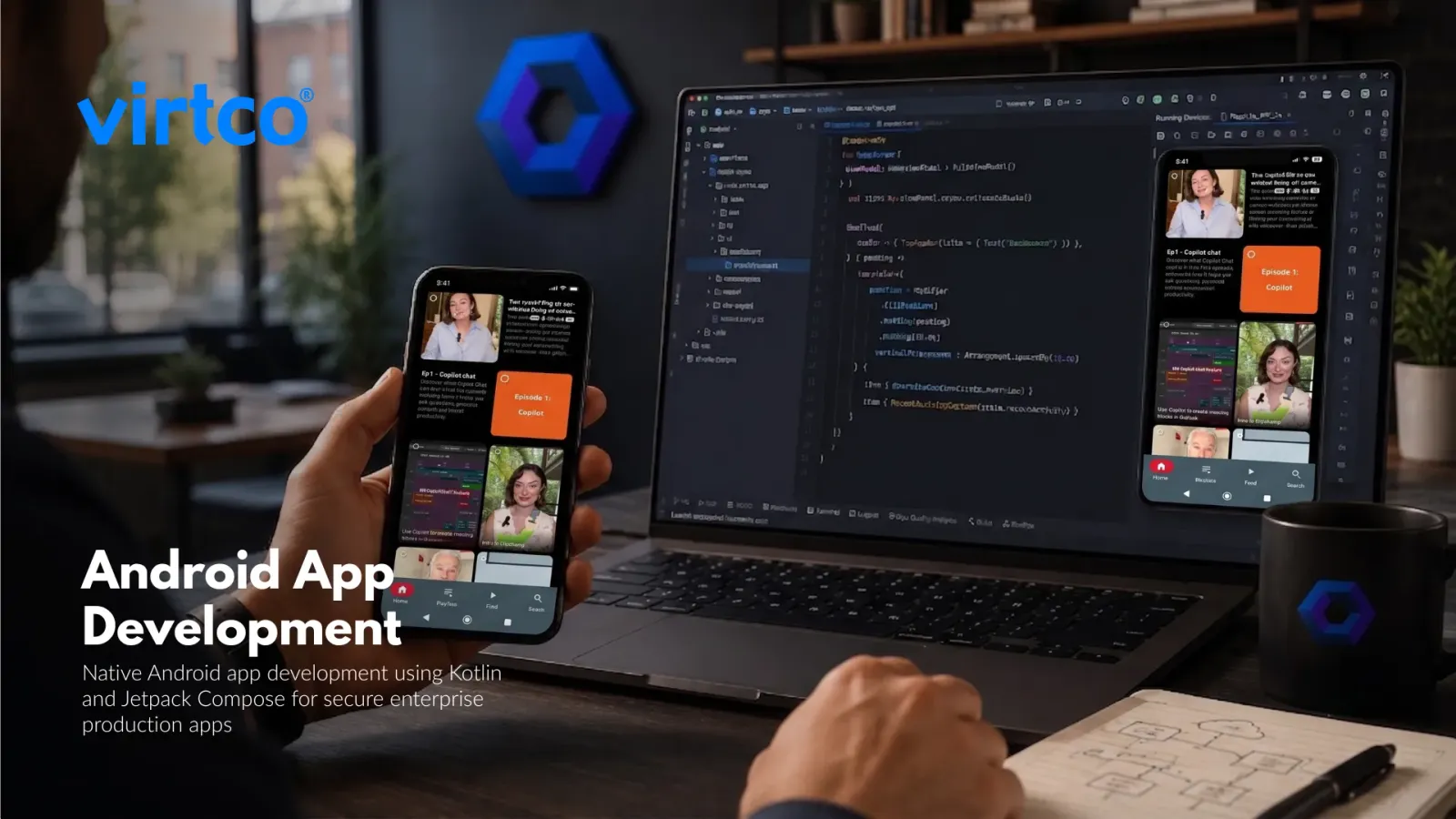
Build or rebuild a native Android app that is fast, secure and ready for real users.
virtco® provides Android app development for UK businesses and product owners who need more than a template app. We design and engineer native Android applications in Kotlin, using Jetpack Compose and modern Android architecture, with the enterprise authentication, integrations and deployment disciplines needed for production.
If you already have a self-built, no-code or AI-assisted prototype that has proved the concept but is starting to show its limits, we can also rebuild the app in native Android so it performs properly, scales cleanly and is suitable for Google Play.
Talk to us about your Android app
Native Android apps, built properly
A good Android app is not just a screen wrapped around a database. It needs clear product thinking, secure access, resilient data flows, careful user experience and maintainable code.
Our Android app development service covers:
- Native Kotlin app development for performance, reliability and long-term maintainability.
- Jetpack Compose app development for modern, flexible Android user interfaces.
- Material Design 3 implementation for familiar, accessible Android experiences.
- Google Play preparation including build configuration, release readiness and store considerations.
- Enterprise authentication using Microsoft Entra ID, Microsoft Authentication Library (MSAL) and single sign-on where required.
- Backend and application programming interface (API) integration with Microsoft 365, SharePoint, Microsoft Graph, customer relationship management (CRM) systems, enterprise resource planning (ERP) platforms and bespoke systems.
- Push notifications, background services and offline-aware design where the use case demands it.
- Security, data protection and tenant separation for apps handling business-critical or customer data.
virtco® is experienced in mobile app development for iOS and Android using native app languages including Swift and Kotlin, and in building scalable, performant and secure custom business applications .
When native Android is the right choice
Cross-platform tools can be useful. So can no-code platforms and AI-assisted prototypes. But there are points where a business app needs native Android engineering.
Native Android is often the better route when you need:
- A polished, responsive user experience on Android phones and tablets.
- Secure Microsoft 365, Entra ID or single sign-on integration.
- Reliable push notifications and device-level behaviour.
- Media playback, location, camera, audio, background tasks or offline operation.
- Strong performance under real usage rather than a demo flow.
- A codebase that can be extended, tested and supported over time.
- A serious route to Google Play rather than an internal experiment.
If you are searching for an Android app developer who understands both product design and enterprise systems integration, this is where virtco® is strongest.
Rebuild an Android prototype as a production app
Many successful products now start as prototypes: a no-code build, an AI-generated proof of concept, a React Native experiment, a spreadsheet-backed workflow or a quick internal tool.
That is often the right first step. The problem comes when the prototype becomes important.
You may start to see:
- Slow screens and unreliable data handling.
- Authentication that is not suitable for enterprise customers.
- Fragile integrations that break as usage grows.
- User journeys that were fine for a demo but awkward in daily use.
- Difficulty adding features without creating more technical debt.
- Concerns from investors, internal stakeholders or customers about scalability and security.
We can take an existing prototype and re-engineer it as a production-grade native Android app. That might mean a full native Android rebuild, a staged replacement of high-risk components, or a deeper architecture redesign across the app, backend and data model.
The aim is not to throw away what you have learned. It is to preserve the validated product thinking while rebuilding the engineering foundations properly.
Enterprise Android app development with Microsoft 365 integration
Many UK business apps need to fit into an existing Microsoft environment. That can include Microsoft 365, SharePoint, Teams, Microsoft Graph, Entra ID, single sign-on and tenant-specific security rules.
This is a core virtco® capability. Our wider technology map includes Microsoft Azure, MSAL, Entra ID, Office 365, Microsoft 365, SharePoint, Teams, Power Platform, API integration, webhooks and workflow automation .
For Android apps, that means we can help with:
- Microsoft Entra ID authentication.
- MSAL public client flows.
- Single sign-on user experience.
- Tenant-aware data access.
- Microsoft Graph integration.
- SharePoint-resident content and document workflows.
- Secure middleware where mobile apps should not call sensitive systems directly.
- Audit, access control and data protection considerations.
If your app needs Microsoft identity or Microsoft 365 integration, see our related service page on Microsoft 365 SSO integration.
Technical proof: Espresso Engage
Espresso Engage is a native enterprise mobile app platform built to bring secure, social-style vertical video to corporate communications. It includes native iOS and Android apps, a web administration portal, backend middleware and push notification infrastructure.
The Android app was built with Kotlin, Jetpack Compose, Material 3, Jetpack Media3 / ExoPlayer, Dagger Hilt and MSAL . The wider platform integrates with Microsoft 365 and SharePoint, using Microsoft Graph upload sessions so corporate video assets remain within the client’s own Microsoft 365 SharePoint document libraries .
The platform also includes secure corporate single sign-on using Microsoft Entra ID and MSAL public client flows with Proof Key for Code Exchange (PKCE), plus tenant isolation in the backend data model to help prevent cross-corporate data leakage .
For the Android experience itself, Espresso Engage uses a native full-screen vertical video feed, recycled ExoPlayer / Jetpack Media3 instances and pre-buffering to support fluid media playback while avoiding unnecessary device memory strain .
This is the difference between template app development and real Android engineering: authentication, content delivery, tenant boundaries, mobile performance, backend design and operational behaviour all have to work together.
AI-augmented delivery, senior engineering judgement
We use artificial intelligence (AI) to accelerate delivery, but not as a substitute for architecture, security thinking or production engineering.
In an internal Espresso Engage delivery study, the delivered ecosystem covered six repositories and 70,834 lines of actual code across native mobile, backend, frontend, administration and dispatcher components. The study recorded 398 hours of human effort, with Android representing 88 full-time equivalent hours in that case . The same source is clear that this is a single case study with methodological limitations, not a universal promise or a replacement for project-specific estimation .
That is how we frame AI-augmented delivery: a way to move faster, explore options and reduce repetitive effort, while keeping experienced human control over architecture, integration, security, testing and release decisions.
Our Android app development process
1. Product and technical discovery
We start by understanding what the app must achieve, who will use it and what systems it needs to connect to. For rebuild projects, we review the existing prototype, code, data model, user feedback and product assumptions.
Typical outputs include:
- Product goals and success criteria.
- Core user journeys.
- Integration and authentication requirements.
- Risk areas and technical constraints.
- A recommended build or rebuild route.
2. Architecture and user experience design
We define the app architecture before heavy development starts. That includes the Android structure, backend responsibilities, API boundaries, authentication model, data storage, push notification approach and release environments.
Where needed, we also design or refine the user interface so the app feels natural on Android rather than copied from another platform.
3. Native Kotlin and Jetpack Compose build
We build the app natively using Kotlin and Jetpack Compose. The emphasis is on clean, maintainable implementation rather than short-term shortcuts.
Depending on the product, this may include:
- Compose screen architecture.
- State management.
- Secure token handling.
- API client layers.
- Offline or cached data.
- Media, location, camera or audio features.
- Push notification handling.
- Analytics and telemetry.
- Accessibility considerations.
4. Backend, integration and security engineering
Many Android apps fail because the backend was treated as an afterthought. We design middleware, data flows and integrations so the mobile app has a secure, reliable foundation.
virtco® has long-standing capability across custom software development, automation, integration, cloud infrastructure and business systems, including API integration, Microsoft platforms, database design, DevOps and workflow automation .
5. Testing, release and iteration
Before launch, we help test the app across devices, user journeys, authentication states, network conditions and integration points. We prepare the release path for Google Play or private enterprise distribution, then support iteration once real users start using the app.
Android app development Manchester and UK-wide
virtco® works with businesses across the UK and is well placed for organisations looking for Android app development in Manchester, the North West or nationally.
For local product owners, that means you can work with an Android app developer who understands both the commercial realities of UK businesses and the technical detail needed for enterprise-grade mobile software.
Related services
Android apps rarely exist in isolation. You may also need:
- Bespoke software development — for the backend systems, portals, workflows and data platforms behind your app.
- iOS app development — if you need a matching native iPhone or iPad app.
- Microsoft 365 SSO integration — if your app needs Microsoft Entra ID, Microsoft 365 or enterprise single sign-on.
Frequently asked questions
Do you only build new Android apps?
No. We build new native Android apps and can also rebuild an existing prototype or under-engineered app in native Kotlin. If the concept is proven but the current implementation will not scale, we can help you plan a native Android rebuild.
Can you work from a no-code or AI-built prototype?
Yes. A prototype can be a useful product specification. We assess what should be retained, what should be redesigned and what needs to be rebuilt properly for production.
Do you build Android apps for Microsoft 365 environments?
Yes. This is a particular strength. We can engineer Android apps that integrate with Microsoft Entra ID, MSAL, Microsoft Graph, SharePoint and Microsoft 365 workflows.
Do you use Kotlin or cross-platform frameworks?
For this service, the focus is native Kotlin app development with Jetpack Compose. virtco® also has wider mobile capability, including React Native and iOS development, but we recommend the technology based on the product, risk profile and long-term ownership needs.
Can you help get the app onto Google Play?
Yes. We can support the technical release process, build configuration and production readiness work needed for Google Play submission. Store approval remains subject to Google’s policies and review process.
How much does Android app development cost?
Cost depends on scope, integrations, user roles, security requirements, backend complexity and whether we are building fresh or rebuilding from an existing prototype. The best first step is a short discovery conversation so we can understand the product and advise on the right route.
Let’s build the Android app properly
If you need a native Android app built from the ground up, or your prototype has proved the idea but reached its engineering ceiling, virtco® can help you turn it into a secure, performant production product.